Siftanox
Origin Deck
Origin Deck
Couldn't load pickup availability
Share
Self-paced learning overview
- 📥 Digital file available after purchase
- ♾️ Long-term availability
- 🔒 Secure checkout
- 📅 Content updated in 2026
1. Problem Statement
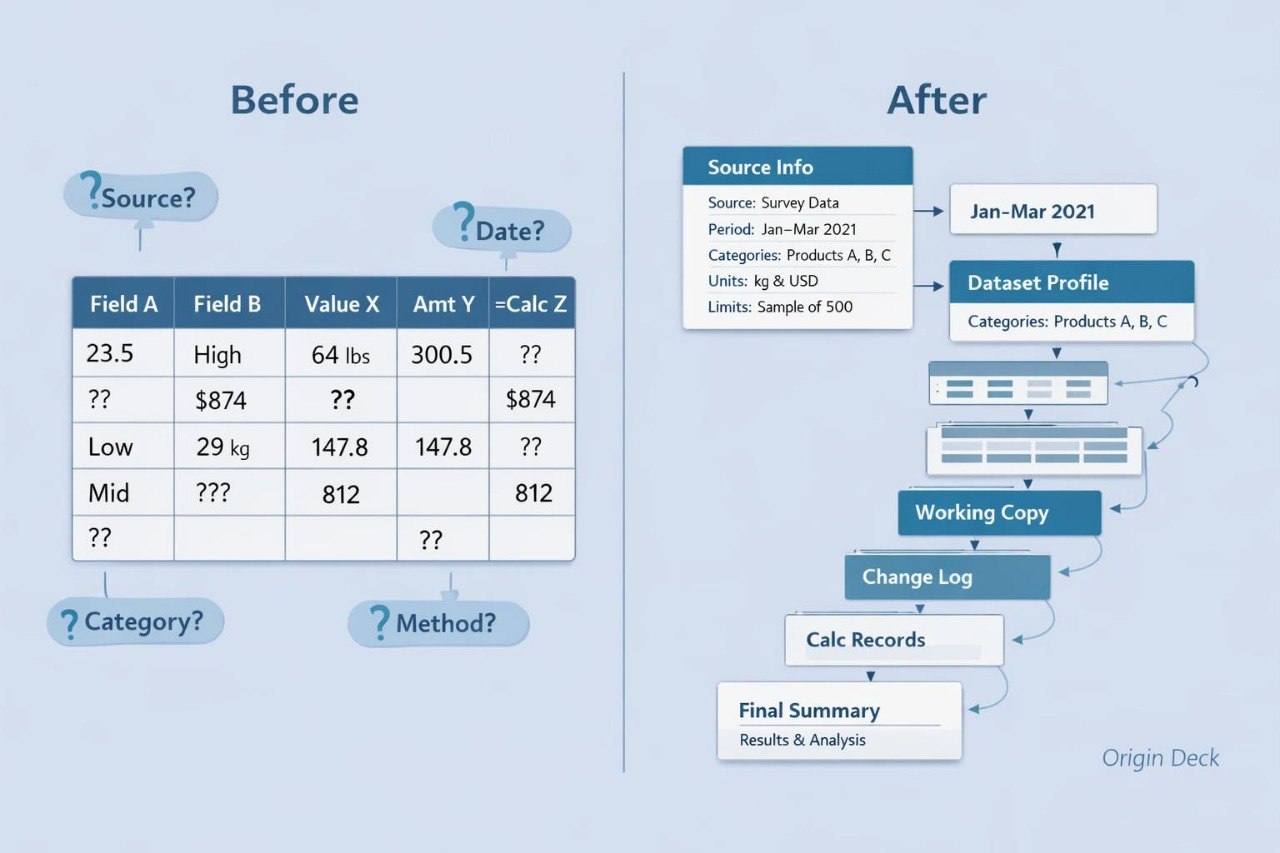
Struggling to determine where data comes from and whether it can be used appropriately for a specific analytical question? You are not alone: a table may appear organized while providing no explanation of its source, collection period, measurement units, or recording rules. Without this context, similar measures may represent different concepts, while comparisons may rely on incompatible conditions. Further difficulties arise after a table has been edited when changes, exclusions, and assumptions have not been documented. Origin Deck treats data origin as a distinct part of the analytical process.
2. Solution
This course will teach you to examine the source, structure, and context of a dataset before beginning calculations. You will learn how to prepare a data profile describing fields, periods, categories, and measurement units. The materials explain how to compare sources, identify differences in collection methods, and document changes made during preparation. You will also learn to separate original records, working versions, and final summary tables. The concluding assignment involves preparing a complete documentation package for a learning analysis.
3. What’s Inside
Module 1: Understanding Data Origins
Identify the source, record creator, collection purpose, and original context. You will prepare a set of questions to consider before using a dataset.
Module 2: Collection Methods and Boundaries
Review how records were gathered, which periods they cover, and which inclusion criteria were applied. The module explains how collection methods may influence table composition.
Module 3: Building a Data Profile
Create a dataset profile containing field names, value types, measurement units, categories, and notes about known limitations.
Module 4: Reviewing Source Consistency
Compare labels, formats, periods, and recording rules across several sources. Learners identify differences that should be considered before matching records.
Module 5: Separating Original and Working Records
Organize the original table, a working copy, and intermediate materials. You will retain the initial structure while documenting edits separately.
Module 6: Change Logs and Decision Notes
Maintain a change log containing the date, action, reason, and effect on the analysis. The module also covers written notes about assumptions and excluded records.
Module 7: Comparing Source Coverage
Examine which periods, categories, and groups appear in each source. You will prepare a coverage table and identify missing segments.
Module 8: Traceable Calculations
Organize calculations so that each summary measure can be connected to its original records and selected method.
Module 9: Writing Source Notes
Prepare a written explanation of data origins, preparation steps, selection criteria, and interpretation boundaries.
Module 10: Origin Documentation Project
Complete a final assignment containing a data profile, change log, coverage table, calculations, and written review.
4. Who Is This For?
✅ This course is suitable if you:
- work with data received from several sources;
- want to document analytical decisions more precisely;
- prepare reports where the origins of measures need explanation;
- already understand basic calculations and comparisons;
- want to separate original records from working materials.
❌ This course may not fit if you:
- are only beginning to study table structure;
- require advanced predictive modelling;
- do not plan to record changes and assumptions;
- expect ready-made conclusions without independent analysis;
- work only with small tables that follow one consistent format.
5. What You’ll Learn
After completing the course, you will be able to:
- describe a dataset using at least eight profile characteristics;
- identify its source, period, measurement units, and inclusion criteria;
- compare the structure of two or more data sources;
- create separate original, working, and summary versions of a table;
- maintain a dated log explaining changes and their reasons;
- document missing categories and time periods;
- connect final measures to their original records;
- prepare a coverage table for several sources;
- write a method note describing interpretation boundaries;
- assemble an analytical documentation package containing five related parts.
6. 30-Day Request Review Terms
A customer may submit a payment return request within 30 calendar days from the order date. Each request is considered under the published Siftanox policy, which describes the submission procedure, review conditions, and possible exceptions. Customers should read the current store terms before completing an order.
7. Course Certificate
After completing all modules and submitting the final project, the learner receives a certificate of completion for Origin Deck. The document records completion of the stated curriculum and lists its main subjects.
1. What format do the courses follow?
1. What format do the courses follow?
Each course contains sequenced modules, written explanations, examples, practical exercises, and materials for independent study. Learners can follow their own schedule and revisit earlier topics when needed.
2. Is previous data experience required?
2. Is previous data experience required?
The recommended starting point depends on the selected plan. Each course page explains which prior knowledge may be helpful and which subjects are covered in the materials.
3. How long does a course take?
3. How long does a course take?
The duration depends on the learner’s study schedule, the number of completed exercises, and the time spent on the final task. Each participant can organize the course around their own routine.
4. What happens after placing an order?
4. What happens after placing an order?
An order confirmation and instructions for receiving the course materials are sent to the email address entered during checkout. The message also outlines the main steps for beginning the course.