Siftanox
Nexus Series
Nexus Series
Couldn't load pickup availability
Share
Self-paced learning overview
- 📥 Digital file available after purchase
- ♾️ Long-term availability
- 🔒 Secure checkout
- 📅 Content updated in 2026
1. Problem Statement
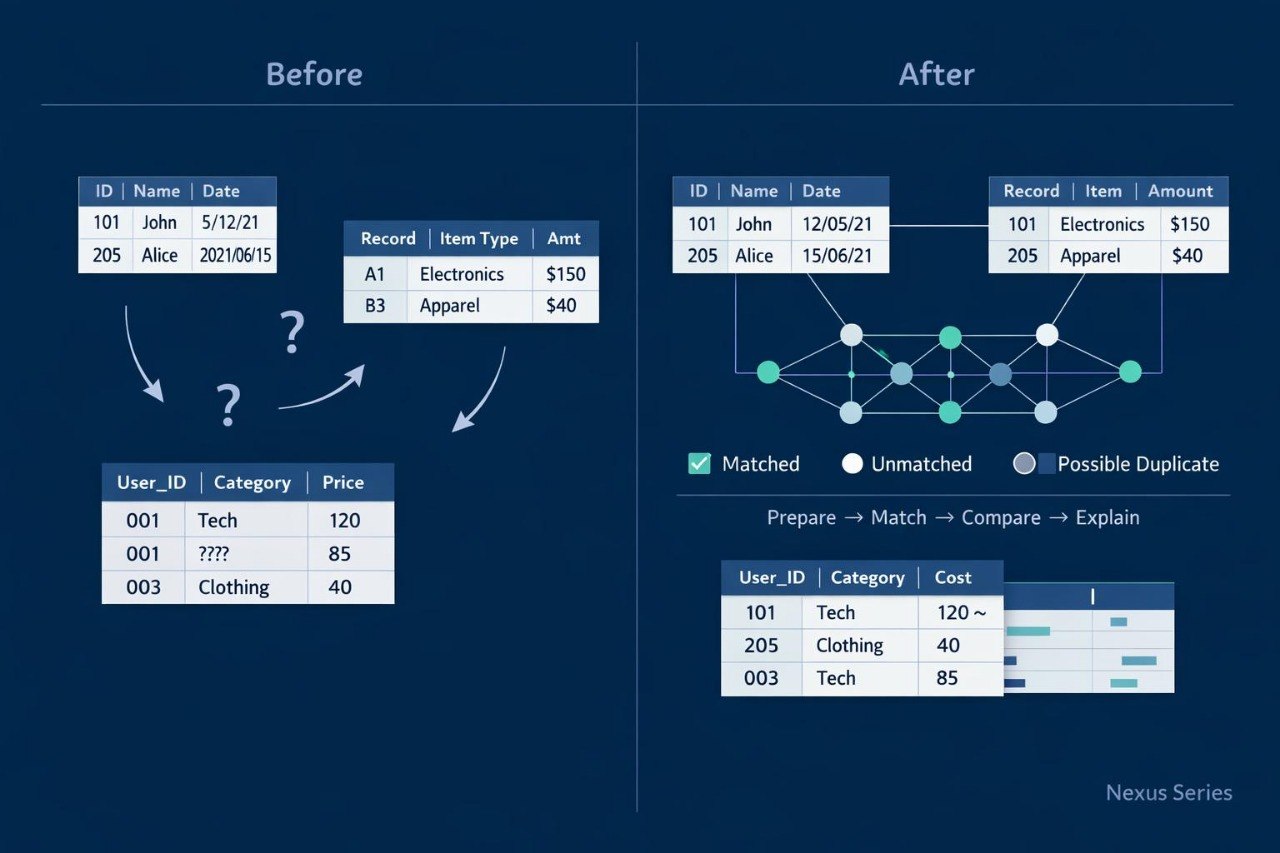
Struggling to combine information from several tables and determine which records genuinely relate to one another? You are not alone: even small datasets can use different field names, date formats, measurement units, and category labels. These differences may lead to inaccurate comparisons, repeated records, or information being left outside the analysis. Another challenge appears when a visible relationship between two measures is incorrectly presented as evidence that one causes the other. Nexus Series introduces an ordered approach to matching data, examining relationships, and documenting analytical decisions.
2. Solution
This course will teach you how to identify shared fields and logical relationships between separate tables. You will learn to examine formats, categories, time periods, and measurement units before combining records. The materials explain how to compare groups, study relationships between measures, and separate observations from assumptions. You will also learn to document changes, selection criteria, and dataset limitations in a concise working record. The final project brings together the preparation of several tables, measure comparison, and a structured written report.
3. What’s Inside
Module 1: Mapping Data Relationships
Identify relationships between tables, fields, and categories. You will prepare a diagram showing which data can be compared and which shared attributes connect the records.
Module 2: Shared Fields and Record Keys
Work with identifiers, codes, dates, and shared labels. The module explains how to examine record uniqueness and locate unclear or repeated matches.
Module 3: Preparing Multiple Datasets
Standardize formats, measurement units, category names, and time ranges. You will create a preparation log containing a concise description of every change.
Module 4: Combining Records Carefully
Review several approaches to matching records. Learners identify matched rows, unmatched entries, and situations where duplicate records may appear.
Module 5: Group and Segment Analysis
Divide information into groups based on selected characteristics. You will compare record counts, averages, shares, and changes between segments.
Module 6: Relationships Between Measures
Study how two measures change in relation to one another. The module explains the distinction between an observed relationship, coincidence, and a causal statement.
Module 7: Time-Based Comparisons
Compare periods, sequences, and recurring changes. You will learn to account for periods of different lengths and incomplete time-based records.
Module 8: Reporting Connected Findings
Prepare a report containing data descriptions, methods, main observations, limitations, and questions for further study.
Module 9: Nexus Connection Project
Complete a final assignment using several learning tables. The project includes preparation, record matching, review, analysis, and written presentation.
4. Who Is This For?
✅ This course is suitable if you:
- already understand basic table structure and value types;
- want to work with several related datasets;
- prepare reports involving different categories and time periods;
- would like to describe relationships between measures more precisely;
- are prepared to document data preparation and analysis steps.
❌ This course may not fit if you:
- are only beginning to study rows, columns, and measures;
- require advanced mathematical modelling;
- expect material about financial or trading strategies;
- do not plan to complete practical assignments;
- want to work only with one small table.
5. What You’ll Learn
After completing the course, you will be able to:
- identify shared fields in two or more tables;
- create a relationship map for several datasets;
- examine the uniqueness of key records;
- standardize date formats, categories, and measurement units;
- locate unmatched, repeated, and incomplete records;
- compare at least three groups using selected measures;
- examine changes across several time periods;
- describe relationships between measures without causal overstatement;
- maintain a data-preparation log;
- prepare a structured analytical report of two to three pages.
6. 30-Day Refund Review Terms
A customer may submit a refund request within 30 calendar days from the order date. Each request is reviewed according to the current Siftanox policy, which describes the submission process, review criteria, and possible exceptions. Customers should read the published terms before completing an order.
7. Course Certificate
After completing all modules and submitting the final project, the learner receives a certificate of completion for Nexus Series. The document records the course title and the subjects included in the curriculum.
1. What format do the courses follow?
1. What format do the courses follow?
Each course contains sequenced modules, written explanations, examples, practical exercises, and materials for independent study. Learners can follow their own schedule and revisit earlier topics when needed.
2. Is previous data experience required?
2. Is previous data experience required?
The recommended starting point depends on the selected plan. Each course page explains which prior knowledge may be helpful and which subjects are covered in the materials.
3. How long does a course take?
3. How long does a course take?
The duration depends on the learner’s study schedule, the number of completed exercises, and the time spent on the final task. Each participant can organize the course around their own routine.
4. What happens after placing an order?
4. What happens after placing an order?
An order confirmation and instructions for receiving the course materials are sent to the email address entered during checkout. The message also outlines the main steps for beginning the course.