Siftanox
Free Set
Free Set
Couldn't load pickup availability
Share
Self-paced learning overview
- 📥 Digital file available after purchase
- ♾️ Long-term availability
- 🔒 Secure checkout
- 📅 Content updated in 2026
1. Problem Statement
Struggling to understand where to begin with tables and datasets? You are not alone: individual numbers may appear understandable while losing meaning when structure and context are missing. New learners often confuse rows, columns, categories, measures, and value types. This can lead to inconsistent comparisons and conclusions based mainly on first impressions. Free Set presents a structured starting process for moving from reviewing data to describing observations with supporting information.
2. Solution
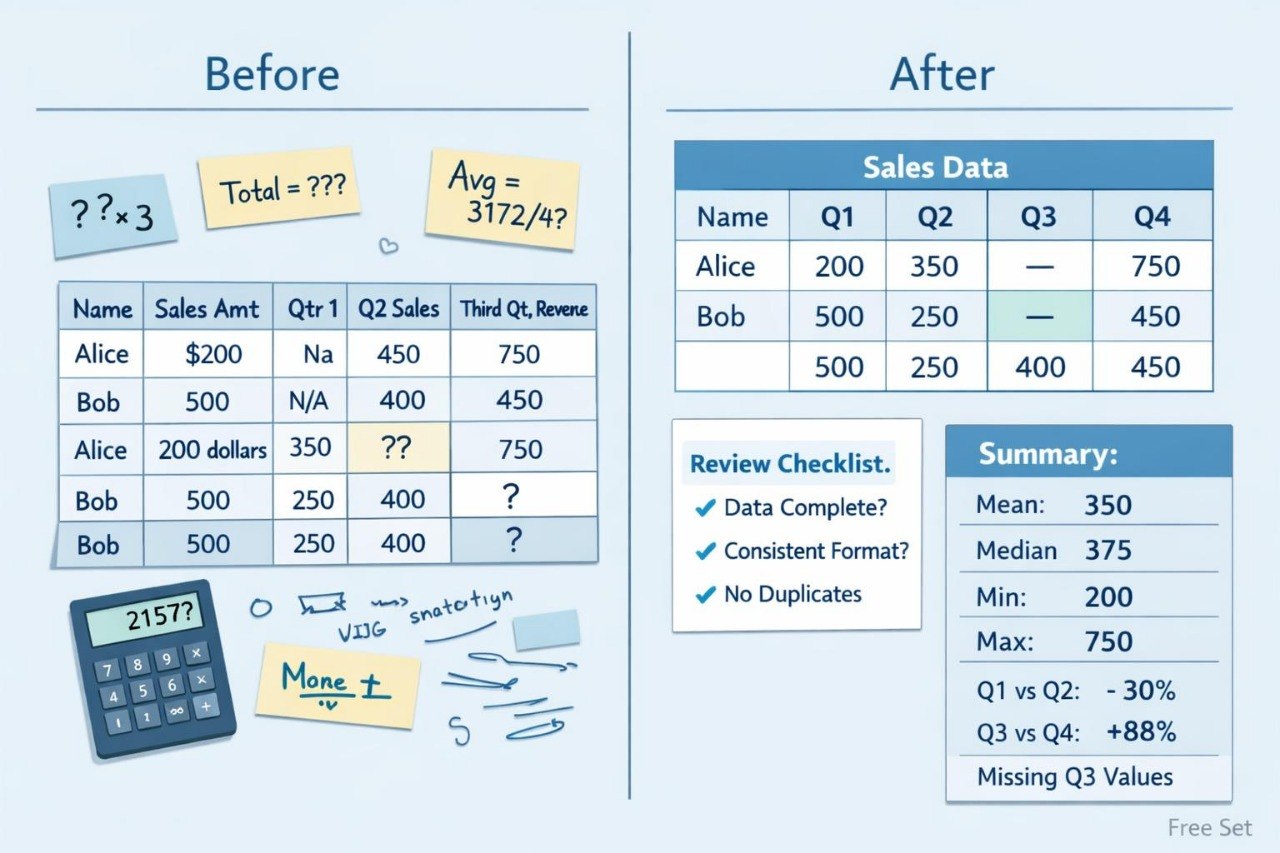
This course will teach you to view a dataset as a system of related elements. You will learn how to identify the purpose of rows, columns, and individual measures. The materials explain how to locate missing values, repeated records, and inconsistent formats. You will also practise calculating basic descriptive measures and comparing groups. At the end of the course, you will prepare a concise analytical summary based on a learning dataset.
3. What’s Inside
Module 1: Reading a Dataset
Examine table structure, field names, rows, columns, categories, and numerical values. Learners practise identifying what each part of a dataset represents.
Module 2: Data Types and Context
Study numerical, text, categorical, and date-based values. This module explains why numbers that look similar can represent different information depending on their context.
Module 3: Basic Data Checks
Review missing values, repeated records, conflicting entries, and inconsistent formats. Learners create a short checklist for an initial dataset review.
Module 4: Descriptive Measures
Work with mean, median, minimum, maximum, counts, and percentages. The focus is placed on interpreting each measure and describing what it shows.
Module 5: Comparisons and Patterns
Compare categories, periods, and groups. Learners practise separating a visible observation from a conclusion that would require further information.
Module 6: Mini Analysis Task
Complete a guided analysis using a learning dataset. The task includes checking structure, calculating measures, comparing categories, and writing a concise findings summary.
4. Who Is This For?
✅ This course is suitable if you:
- are beginning your study of data analysis;
- work with tables, reports, or lists of measures;
- want to examine data before forming conclusions;
- prefer sequenced explanations and practical exercises.
❌ This course may not fit if you:
- need advanced statistical modelling;
- expect in-depth programming material;
- already work regularly with complex analytical systems;
- are looking for financial forecasting or trading strategies.
5. What You’ll Learn
After completing the materials, you will be able to:
- identify rows, columns, fields, and value types within a dataset;
- perform at least five basic data-quality checks;
- locate missing, repeated, and conflicting records;
- calculate mean, median, minimum, maximum, counts, and percentages;
- compare two or more categories using a selected measure;
- create a concise table of key findings;
- write three to five observations without overstating what the data shows;
- prepare a one-page analytical summary.
6. 30-Day Review Terms
A customer may submit a refund request within 30 calendar days of placing an order. Each request is reviewed under the published Siftanox refund policy, including its conditions, exceptions, and contact procedure. Customers should read the current policy before completing an order.
7. Course Certificate
After completing every module and the final task, the learner receives a certificate of completion for Free Set. The certificate records completion of the stated course curriculum.
1. What format do the courses follow?
1. What format do the courses follow?
Each course contains sequenced modules, written explanations, examples, practical exercises, and materials for independent study. Learners can follow their own schedule and revisit earlier topics when needed.
2. Is previous data experience required?
2. Is previous data experience required?
The recommended starting point depends on the selected plan. Each course page explains which prior knowledge may be helpful and which subjects are covered in the materials.
3. How long does a course take?
3. How long does a course take?
The duration depends on the learner’s study schedule, the number of completed exercises, and the time spent on the final task. Each participant can organize the course around their own routine.
4. What happens after placing an order?
4. What happens after placing an order?
An order confirmation and instructions for receiving the course materials are sent to the email address entered during checkout. The message also outlines the main steps for beginning the course.